

Adaptive Growth That Knows When to Play It Safe.
Up to 2.5× the Nasdaq when the conditions are favourable, fully into T-bills when they're not.
As featured in


You remember 2022. The every-morning check. The same question — ride it out, or get out? Holding meant riding down 18%. Selling meant watching the recovery from cash — 24%, then 23%.
Sitting through the next one is optional. Hold-through-everything is a pre-internet playbook. Kairos sidesteps instead — T-bills when conditions break, back in when they clear. 2022: up 8% while the market fell 18%.

1952
Modern portfolio theory is published — the math behind “diversify and hold.”
1976
The first index fund launches. The internet is still twenty years away.
2026
Same playbook, still sold as the default — in a market machines trade.
Five checks. Then Nasdaq — or T-bills.
Watching the Nasdaq is how you find out late. The five-factor macro regime scores five public checks at 3:50 PM each trading day. Healthy — the slice stays in Nasdaq. Fragile — it parks in T-bills.
Five-factor macro regime
Public data · 3:50 PM ET
Credit spreads
What companies have to pay extra to borrow.
When lenders get nervous, they charge more to hold company debt. That usually prints in the bond market before it prints on your Nasdaq chart. The model reads that gap every day — not the headline that comes after.
Illustrative — not actual trade history.
Signals can be late or wrong. Switching can create whipsaw (wrong twice in a row) and does not prevent losses or guarantee downside protection.
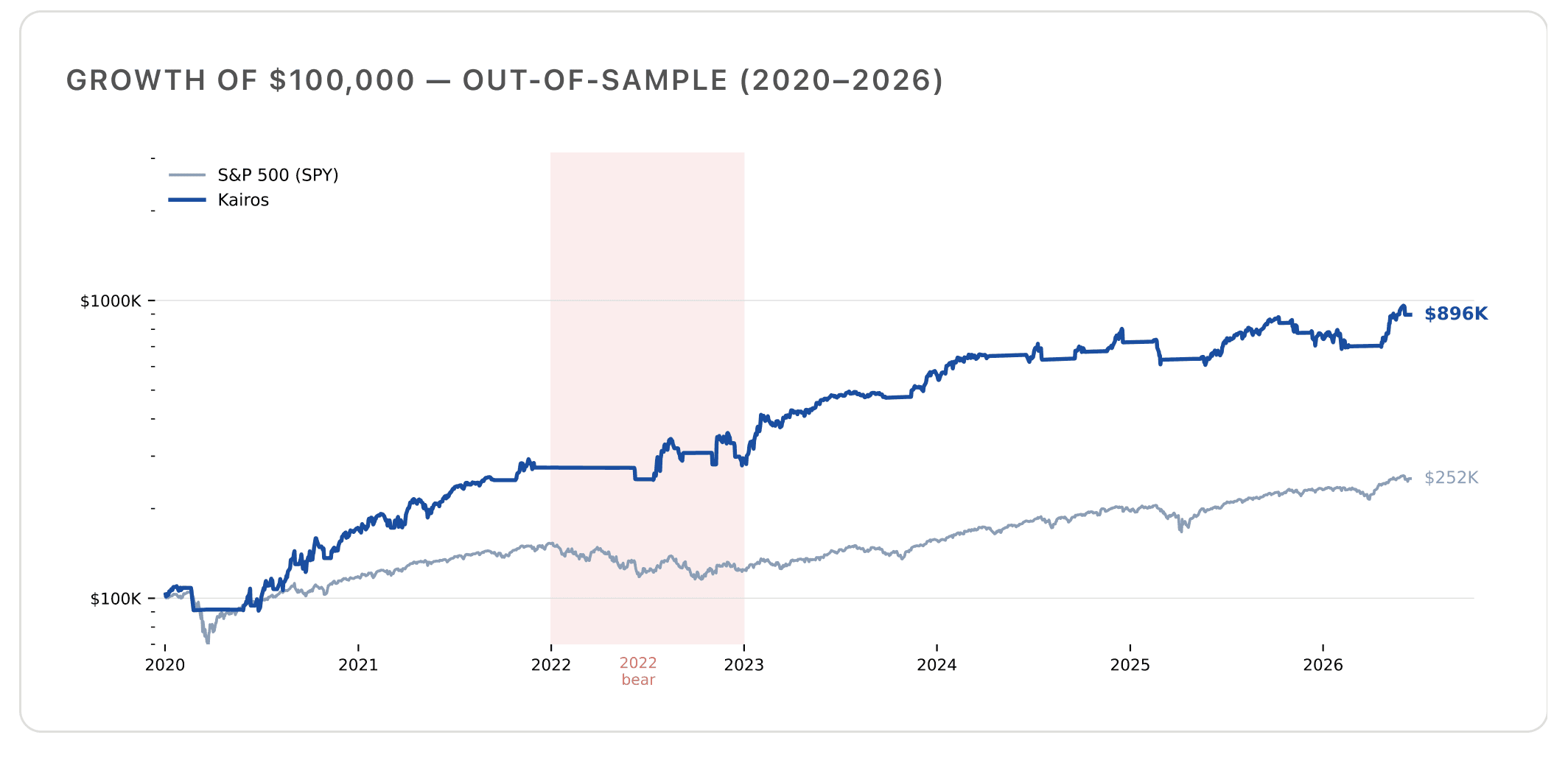
Same $100,000. Very different ending.
Out-of-sample 2020–2026 — a period the model never trained on. Includes the 2022 bear, when SPY fell 18% and Kairos was up 8%.
40.6%
Annualized return
SPY did 15.5% same window
1.39
Sharpe ratio
SPY: 0.81
−24.5%
Worst drawdown
SPY: −33.7%
$896K
What $100K became
SPY: $252K
Backtested, out-of-sample results — not an audited or live trading account, and individual results will vary. Leveraged ETFs like TQQQ reset daily and can lose money even in a flat or choppy market. Past results don’t guarantee future ones. Not advice to buy anything.
How Max developed the system.

Maxwell Hines
Max has managed risk at three very different scales: co-managing more than $120 million in client assets, trading his own futures book for two and a half years, and co-managing a $90 billion book of business at AllianceBernstein.
That experience showed him how institutional portfolios are run: systematic strategies, strict risk frameworks, and decisions made before emotion enters.
He coded that discipline for private accounts—five market conditions evaluated daily at 3:50 PM ET, with every exit and re-entry determined in advance.
AllianceBernstein is named to describe prior work experience only. It is not affiliated with Kairos and does not sponsor, endorse, or review this strategy.
Built for every investor.
Every one of them runs into the same two decisions: when to get out, and when to get back in. Kairos has a written rule for both.
The market doesn't care that you're in meetings.
Kairos checks conditions every trading day at 3:50 PM ET and makes the call for you — growth while the trend holds, T-bills when it breaks. About 11 trades a year. You'll barely hear from it.
- No screens to watch, no alerts to act on
- The rules decide — not your calendar
- Runs inside your own brokerage account
Start with one system. Add the others when you’re ready.
Kairos Select is the flagship, where most accounts start. Enhanced and Futures sit alongside it when you want a second engine working. Different jobs, one standard: written rules, no gut calls, and twelve months to change your mind.

The selection system
Start hereKairos Select
Owns the ~40 highest-ranked U.S. stocks on a four-factor rank, and re-ranks them every week. No stock-picking, no headlines, no gut calls.
- ~40 names, re-ranked weekly
- Rebalances when a holding drifts 3% off target
- Fully invested, always long
Tracked live since 30 September 2025.
The blended system
Kairos Enhanced
Kairos Select with the risk signal on top. Same stock portfolio, plus a small market sleeve set daily.
- Select core, always long
- 15% sleeve, set by the daily signal
- The only way to get the Kairos signal
The sleeve leans into Nasdaq when conditions hold, and steps aside when they don't.
The intraday system
Kairos Futures
Trades Nasdaq futures on a fixed rule set. Set entries, set stops, and nothing held overnight.
- NQ / MNQ, 15-minute chart
- Trades only when setups qualify
- Runs alone on its own account
The most aggressive of the three. Not for the nest egg.
12 months for it to earn its spot. If you’re not happy, get a refund in full.
Kairos Select and Kairos Enhanced records are live tracked models beginning 30 September 2025, under one year, gross of fees and slippage, and not audited. Kairos Futures figures are illustrative. Running more than one system means more exposure, not less risk.
The stuff people actually ask.
Practical first. The model if you want it. Numbers if you want to argue with them.
Money, the account, and what happens on the call.
Where does my money actually sit?
In your own brokerage account, in your name. We never take custody and never pool funds — the system places trades, and that’s all it does. No lock-up, no surrender period, and it runs one slice of your portfolio rather than the whole thing. Switch it off the same day you decide to.
What if it doesn’t work out for me?
You get a full year to decide. Not satisfied inside 12 months and every dollar you paid us comes back — no exit interview. To be precise about what that covers: it refunds our fee, not market losses. Nobody can guarantee an investment return, and we don’t. What we can guarantee is that you won’t be stuck paying for something you don’t want.
Do I have to pick which system to use?
No. Most start with Kairos Select — the stock book, long, held for weeks to months. Enhanced is Select plus a 15% sleeve that can press Nasdaq or park in T-bills. Futures is a separate intraday Nasdaq book. Which combination fits you is the first thing we work out on the call.
What if I’m sitting in cash right now?
Then you already know the trap: getting out was the easy call, and nobody can tell you when it’s safe to get back in — so “safe” keeps not arriving while the market runs. The same written rule that steps aside steps back in. You stop being the one who has to call the bottom.
Why sell this instead of just running your own money?
Fair thing to ask anyone selling a system. Max Hines built it after co-managing a $90 billion book in portfolio management at AllianceBernstein — and before that, two and a half years trading futures on his own book. He has said roughly 80% of his liquid equity, outside crypto, sits in Enhanced. Running it properly for real portfolios is the business; there’s nothing to protect by keeping it quiet.

The exit is already written. So is the way back in.
Watch the switch on the live record — thirty minutes, books open. Your money stays in your brokerage the whole time.
Give Kairos a try5 quick questions · 12 months to change your mind · no obligation